
Redeeming Tempelhof: Black Friday to the Easter Parade
Tempelhof's vital role in the Berlin Airlift recast Hitler's airport as a symbol of freedom.

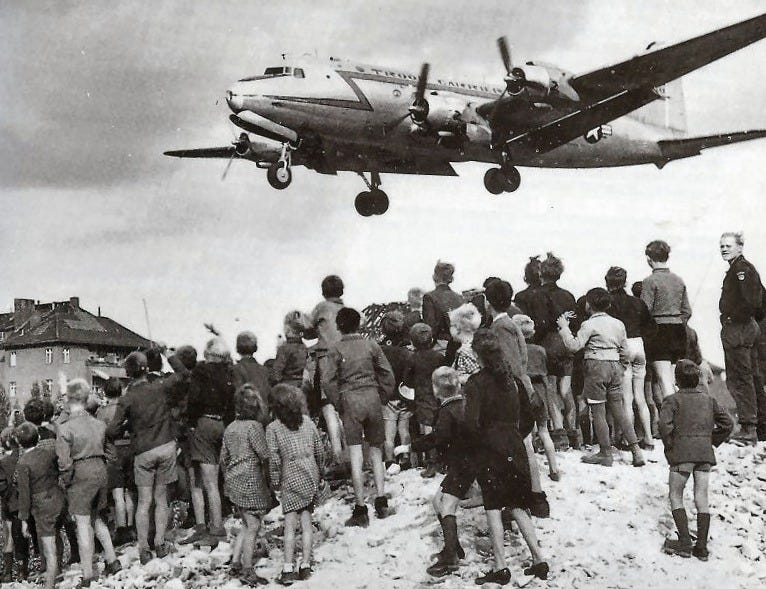
US General William Tunner peered out through the windshield into the soup of dark clouds. Though visibility was minimal, his pilot kept a steady course. The plane flew in a conveyer belt of identical craft, spaced exactly three minutes apart, towards Berlin.
At nearly two months old, the Berlin Airlift, the Allied operation to supply the city’s blockaded Western sectors by air had settled into a smooth rhythm. Now, Tunner, as its new commander, was heading to the city for a ceremony to congratulate the crews.
Unfortunately for Tunner, this Friday 13 August, 1948, the US pilots faced what was for them a new challenge: the treacherous German weather. Taking off in bright sunshine, the planes hit black scudding clouds and driving rain over the Harz mountains.
At Tempelhof Airport, the US-held airbase in central Berlin, conditions were worse still. The dark clouds hung so low that they skimmed the tops of the buildings surrounding Tempelhofer Feld. Cloudbursts exploded, sending sheets of rain across the site.
Sitting in the tower, Tempelhof’s air traffic controllers could suddenly no longer see the runway or the incoming planes. Even their simple radar systems lost track of the machines through the wall of rain. But the planes kept descending out of the cloud.
In the confusion, a plane overshot the runway, skidded into a ditch and burst into flames. The crew scrambled out, lucky to be alive, even as the next plane appeared. It too, overshot, and began speeding towards the burning wreck of the first.
The pilot slammed on the brakes and skidded. It stopped, just in time, with both of its tires blown out. A third plane arrived and, accidentally landing on a half-built auxiliary runway, slipped along the rubber base and spun into an uncontrolled ground loop.
In the tower, chaos reigned. Air traffic control was scrambling to get a hold on the situation. All landings and take offs were halted. Planes were to circle in a tight stack above the airport. There was nowhere else to go. Allied airspace in Berlin was tiny.
More planes joined the stack every few minutes. Soon they formed a huge spiral, spinning blindly through thick cloud. By the time Tunner arrived, aircraft were stacked above Tempelhof from 3,000 to 12,000 feet. It was a disaster waiting to happen.
Viewing the chaos from his plane, and hearing the panicked pilot chatter on the airwaves, Tunner flew into a rage. In the airport below, thousands were gathering for a self-congratulatory ceremony. This wasn’t just dangerous, it was embarrassing.
Tunner grabbed the radio mic. Send every plane back to its home base, he told the tower, then let him know when it was safe to land. On the ground, he gave the air traffic controllers a talking to, then he issued a set of new rules.
Any plane that missed its landing window would return all the way to their base in the West and start again. The Airlift would operate a one way system. Approach Berlin along northern and southern corridors. Departure via the central one.
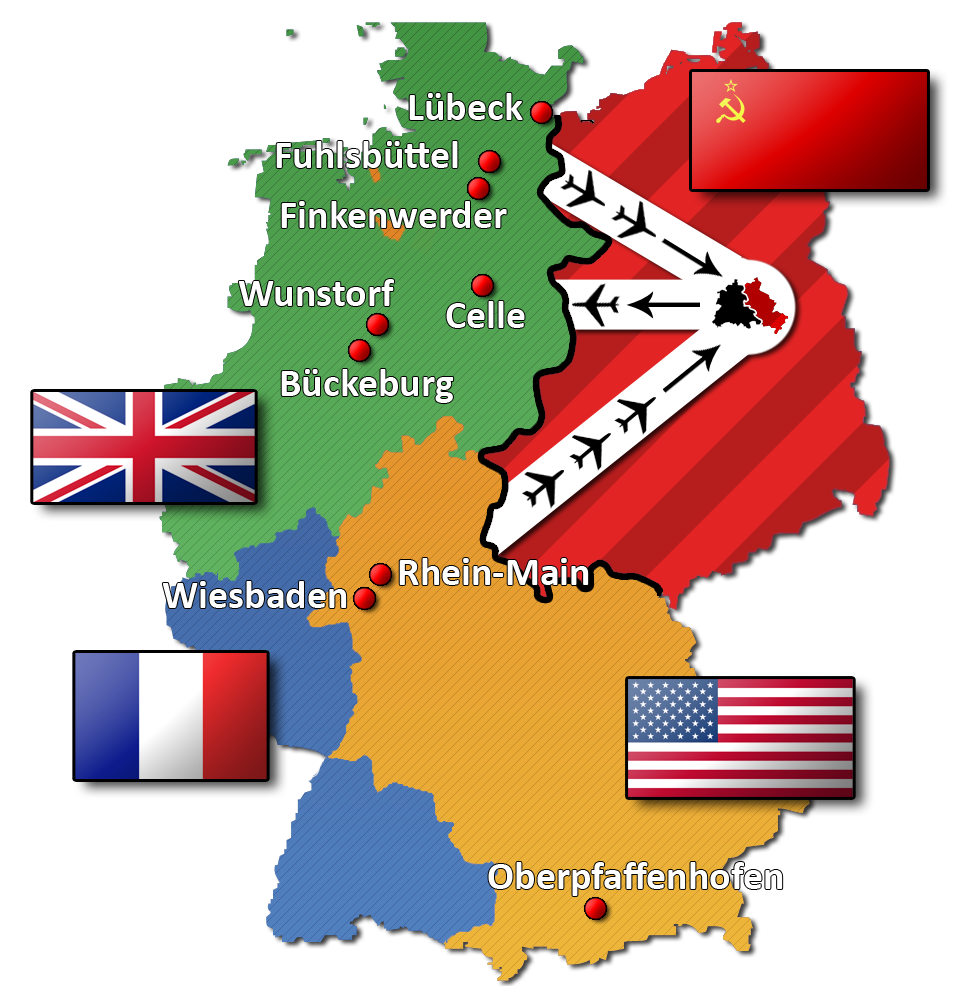
#/media/Datei:BerlinerBlockadeLuftwege.png)
The operation tightened up. But winter was looming. The Soviets knew that if it was harsh, the Airlift would fail to meet demand for coal to heat homes. The Allies too began to doubt they could fulfil their sky-high promise to the Berliners.
The Airlift needed a miracle. In the end, it got three. First, more planes arrived from the US. Second, a new airport opened at Tegel to relieve Tempelhof and the RAF base at Gatow. And third, a new radar system allowed Tempelhof to coordinate the entire Airlift from one base.
The winter, too, was mercifully mild. By March 1949, the Airlift was surpassing its targets for daily tons of coal, food and other essential goods. The Allies could now supply Berlin indefinitely by air. Tunner decided to drive home the point with a stunt.
Over Easter weekend there was to be a show of strength. Tunner visited bases in person to rally the pilots. The results surpassed all expectations. On one day, 16 April 1949, the Airlift shifted a record 12,849 tons, more than double its typical daily load.
The Airlift’s triumphant finale became known as the “Easter Parade.” The following month, the Soviets lifted their blockade of Berlin. The Allies continued to fly in goods until September, building up stocks and showing Berliners they intended to stay.
The Airlift’s success forever cemented Tempelhof Airport in the hearts of Berliners. Hitler’s airport - once home to a concentration camp and forced labour barracks - was recast as a symbol of freedom, overwriting memories of war, cruelty and oppression.